
Open a copy of the original 1987 Viz Media edition of Lone Wolf and Cub and then open a current Viz release of Jujutsu Kaisen. The difference is immediate. One reads left-to-right, its panels flipped to mirror Western comics conventions. The other preserves the original right-to-left flow, exactly as Gege Akutami drew it. How English manga moved from that heavy-handed adaptation toward something far more faithful – visually and textually – is a story about changing reader expectations, publisher risk tolerance, and manga’s growing confidence as a global medium. This article traces that shift through publishing history, current translation practice, and the readers driving demand for it.
From Flipped Pages to Faithful Formats
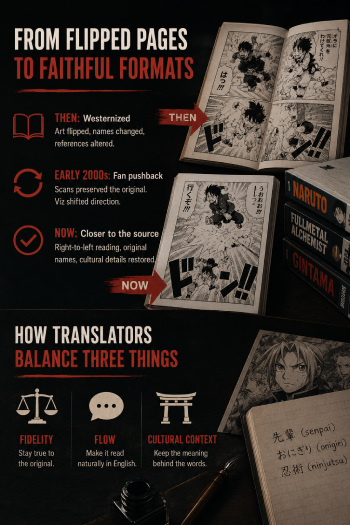
When the eighties were about to end, it was one of those rare moments when an early English release of Dragon Ball was like another publication culture alien to Viz Media’s till then. Mirroring the artwork was to change the direction it faced so that western audiences could follow the sequence; sound effects were re-done in English, and names were re-ordered in American format. The idea was that the American audience wouldn’t be able to get used to Japanese conventions.
The assumption becomes early 2000s right when fan pushback commenced to apply a roadblock. During early 2000s, fan communities were all lauding scanned versions–the ones that kept the original formatting–against locally transformed print versions. With the relaunch, Viz began right-to-left reading in books like Naruto and sometimes afforded a glossary to honorifics.
The transition is more pronounced in recently issued titles compared to older ones. In Fullmetal Alchemist, re-edited by Viz in 2013, this includes a restoration of the name sequence and the Japanese cultural markers discreetly removed by the first edition.
How Translators Balance Fidelity, Flow, and Cultural Context
Open any volume of Fullmetal Alchemist and the English reads naturally, almost invisibly so. That smoothness is deliberate, and it costs something.
Fidelity means staying close to the original Japanese text. Localization means reshaping it so English readers feel what Japanese readers felt. Most modern translators work somewhere between both, making dozens of small judgment calls per chapter.
Puns are where things get genuinely hard. Japanese wordplay rarely survives a literal transfer, so translators often construct an English equivalent from scratch, preserving the joke’s function rather than its form. Dialects present a similar problem. Gintama’s Osaka-inflected characters are sometimes rendered in Southern American English, a choice that divides fans sharply.
Cultural terms create another layer. Words like “senpai” or “onigiri” are now frequently left untranslated, with glossaries added instead. Translator Zack Davisson has noted that panel space alone can eliminate a perfectly accurate line, forcing cuts that change a character’s rhythm entirely.
Why Today’s English Editions Feel Different to Readers
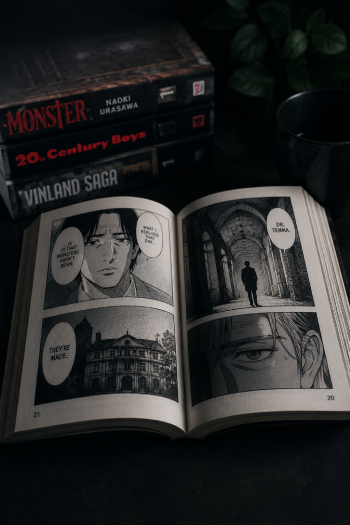
Pick up a recent Viz Media or Kodansha USA release and the differences from editions printed fifteen years ago are immediate. Pages run right-to-left without apology. Sound effects stay in Japanese, with small translated glosses tucked nearby rather than clumsy English replacements painted over the art. Translator credits appear on the copyright page, sometimes with brief notes explaining a cultural reference or an untranslatable pun.
These shifts didn’t happen quietly. Online fandom, particularly communities on Reddit and Twitter, spent years calling out awkward localizations and demanding better. Publishers listened, partly out of respect and partly because the audience grew sophisticated enough to notice.
For newcomers, the result is cleaner and more immersive. For longtime readers, the payoff is different. A retranslation like Viz’s 2022 reissue of Naoki Urasawa’s Monster restores tonal precision that earlier editions softened. Characters sound like themselves again. That kind of fidelity is what fans had been asking for all along.
English Editions Now Shape How Manga Travels
Somewhere between Japanese print houses and the English reader’s shelves, a manga volume faces changes that are little seen but deeply felt. Some horrors include the Japanese reading direction, honorifics, sound effects rendered in English in romaji or the unfamiliar completely, and cultural references that are like made on the assumption that the reader has knowledge that few Western readers do. The best-produced versions can encompass all this simultaneously. With publishers like Kodansha USA and Viz Media, we have given up on hourly translations, and instead, their productions end up being a genuine reading experience, rather than simply a mere language exchange.
English is definitely the primary medium for anticipating ways in which various language markets receive various pieces of material. Yet again, the English could almost as easily be characterized as rhythmically Japanese alignment contributing greatly to the reader’s as ever. Words twisted around from Japanese syntax behave as a fixed lattice of reverse frames to meet the eye. By some miracle, words signifying eloquence but always make sense in English are kept parallel with the visual grammar of a left-to-right page in a tight fight for the attention of a reader such that, for all one believes in, the singular reader will finish the finished prose and balk at the idea that they’re reading anything other than the original, or something almost as wild in its tamer, glossy rendering.