
Mechademia 1 matters because it captures a moment when anime and manga studies were becoming more visible as a serious area of cultural analysis, without losing sight of the passion that brings people to these works in the first place. It helps connect the ways fans talk about stories, characters, and worlds with the kinds of questions scholars ask about media, meaning, and society.
What Mechademia Is, and Why Volume 1 Stands Out
Mechademia is a publication series devoted to critical conversations about anime, manga, and related visual cultures. Rather than treating these media as niche entertainment, the series approaches them as rich cultural forms shaped by history, technology, art, and global circulation. Each volume gathers different voices and methods, which makes the series feel less like a single argument and more like an ongoing discussion about what anime and manga can do.
Volume 1, titled “Emerging Worlds of Anime and Manga,” sits near the start of that conversation. It reflects an early effort to frame anime and manga as subjects that can carry theory without being reduced to “examples” of theory. The volume’s focus on “worlds” highlights how many anime and manga invite sustained attention: not only to plot points, but to systems of life, rules of physics, social structures, and imagined futures that feel coherent enough to live in mentally.
Key Thematic Areas Explored in “Emerging Worlds”
The idea of “emerging worlds” pulls several threads together. It suggests worlds that are coming into being through storytelling, art style, and viewer interpretation, and it also hints at worlds shaped by historical pressures such as modernization, war memory, and digital technology. The volume tends to treat world-building as more than background decoration, asking what kinds of lives and values become thinkable inside these settings.
- World-Building and Imagined Futures
- Technology, Identity, and Embodiment
- Genre Experimentation and Hybrid Forms
- Cultural Exchange Between Japan and Global Audiences
Interdisciplinary Ways of Reading Anime and Manga
Being knowledgeable about problem-solving means understanding that there is often more than one way to interpret and solve an issue like, say, an anime without spelling out the rules of the bounds of one interpretation. This issue involves other disciplines such as media studies having a view of format, distribution and related issues. By contrast, cultural studies or sociology might be more concerned with social anxieties, and philosophy with questions how the self and the body are defined or, what a sense of self or body is potential bodily threat.
Academic Analysis and Fan Interpretation: Shared Habits of Attention
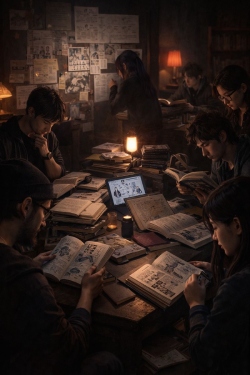
Before getting into any specific angles, it helps to name what academic work and fan engagement often share: close attention. Fans who track continuity, debate character motivations, or map out timelines are already practicing a kind of interpretation that takes fictional worlds seriously. Mechademia 1 treats this seriousness as worth examining, not as something to apologize for.
How “Deep Reading” Shows Up in Fandom
The volume’s focus on worlds makes it easier to see fan practices as forms of world literacy. People notice rules, exceptions, and consequences, and they test whether the world can hold together under pressure. That kind of reading is not only about admiration or enjoyment; it is also about how a story earns trust through consistency, ambiguity, or productive contradiction.
How Scholarship Reframes Familiar Questions
Academic analysis often starts from questions fans already ask, then shifts the frame. Instead of only asking “What happened?” it may ask “What conditions make this feel possible?” or “What assumptions does this world treat as normal?” Mechademia 1 shows how this reframing can coexist with affection for the medium, because it treats interpretation as a way of understanding how stories work, not as a way of scoring them.
Why “Emerging Worlds” Is a Useful Concept
“Emerging worlds” is a helpful phrase because it points beyond surface style and beyond a summary of events. Many anime and manga don’t just tell stories inside a pre-built setting; they reveal the setting gradually through perspective, conflict, and atmosphere. The world emerges through partial glimpses, through the way technology is drawn, through what characters fear, and through what the narrative refuses to explain too neatly.
A Continuing Conversation, Not a Final Word
Mechademia 1 stays important since it provides an argument on how anime and manga can be discussed even in the most constructive way. It does not perform theory as an obstruction to keep “respectable” readers isolated from the fans, it doesn’t abandon the sentiment of the fan as separate from culture. But how can one speak of worlds that do not exist as if they were real, that is, as subjects of intellectual engagement, so that they continue to serve as arenas around which people and cultures go in cycles.